
Fan The Spark

Category

Mind & Meaning

A small gathering of essays under mind & meaning.

Vaisesika Dasa

Vaisesika Dasa·May 10, 2026

We humans have very short lives. Measured by geological time, our lifespans are not even a nanosecond. Nonetheless, the bhakti scriptures say that this brief period is enough for anyone to attain spiritual perfection. What is more, they reprove as irresponsible and miserly those who do not utilize their lives to attain such perfection. Having so much at stake with so little time may seem daunting.

A drop of dew on a tulasi leaf, lit from behind by morning light.
Dawn on a tulasi leaf — a single instant, fully inhabited.

To inspire us, Sukadeva Goswami tells us in Srimad-Bhagavatam the story of Maharaja Khatvanga, who perfected his life within an instant. Srila Prabhupada summarizes Khatvanga's achievement plainly:

"King Khatvanga went to assist the demigods, and he was rewarded. When asked what he wanted, he replied, 'I want to know how long I shall live.' 'Not very long,' they said. 'A second.' He at once transferred his thoughts to Krishna and surrendered."

Srila Prabhupada, Back to Godhead Magazine #45

Not a license to wait

Maharaja Khatvanga's story is not meant to encourage procrastination. I can almost hear the convenient misreading: oh, this means I can do as I wish throughout my life and at the last moment remember Krishna. But Krishna and the great teachers of bhakti never encourage us to delay our spiritual practices in this way.

On the contrary, Sri Sukadeva tells us this story so that we may make each moment of our lives a Khatvanga moment. Though our lives are fleeting, they are made up of a series of moments — any one of which we may use to attain the supreme perfection of life by taking shelter of Krishna.

What seriousness actually does

Srila Prabhupada confirms this idea with a sentence worth keeping near the door of one's attention:

"Devotional service is not a material process — it is spiritual. It involves no impediments of material conditioning. It develops in proportion to one's seriousness; we can attain the whole thing in one second. If we sincerely take Krishna consciousness, we have it."

Srila Prabhupada (ibid.)

The instruction is exact and merciful at once. The door is always open. The hour need not be long. What is asked of us is only the willingness, this moment, to step quietly through it.

Permalink

Vaisesika Dasa

Vaisesika Dasa·April 12, 2026

You are an atma, a spiritual entity that has nothing at all to do with this material world. You cannot be killed, cut, burned, or drowned. You are eternal.

Feel better now?

Finer than intelligence

"Finer than intelligence is the soul, which is not matter like mind and intelligence but is spirit, or antimatter. The soul is hundreds of thousands of times finer and more powerful than intelligence."

Sri Caitanya-caritamrta, Adi 5.22, purport

We forget this most of the time, and the forgetting is itself a kind of weather we live inside. The reminder, when it arrives — in a verse, in a teacher's sentence, in the small clearing of an unhurried morning — does not add anything new. It only restores what was already, quietly, the case.

Om Tat Sat.

Permalink

Vaisesika Dasa

Vaisesika Dasa·March 30, 2026

Once, while working on a deadline, my computer caught a small persistent virus. The same alert kept reappearing, no matter how many times I dismissed it. Eventually a friend who knew the system walked me through running the right cleanup program, and the machine returned to itself.

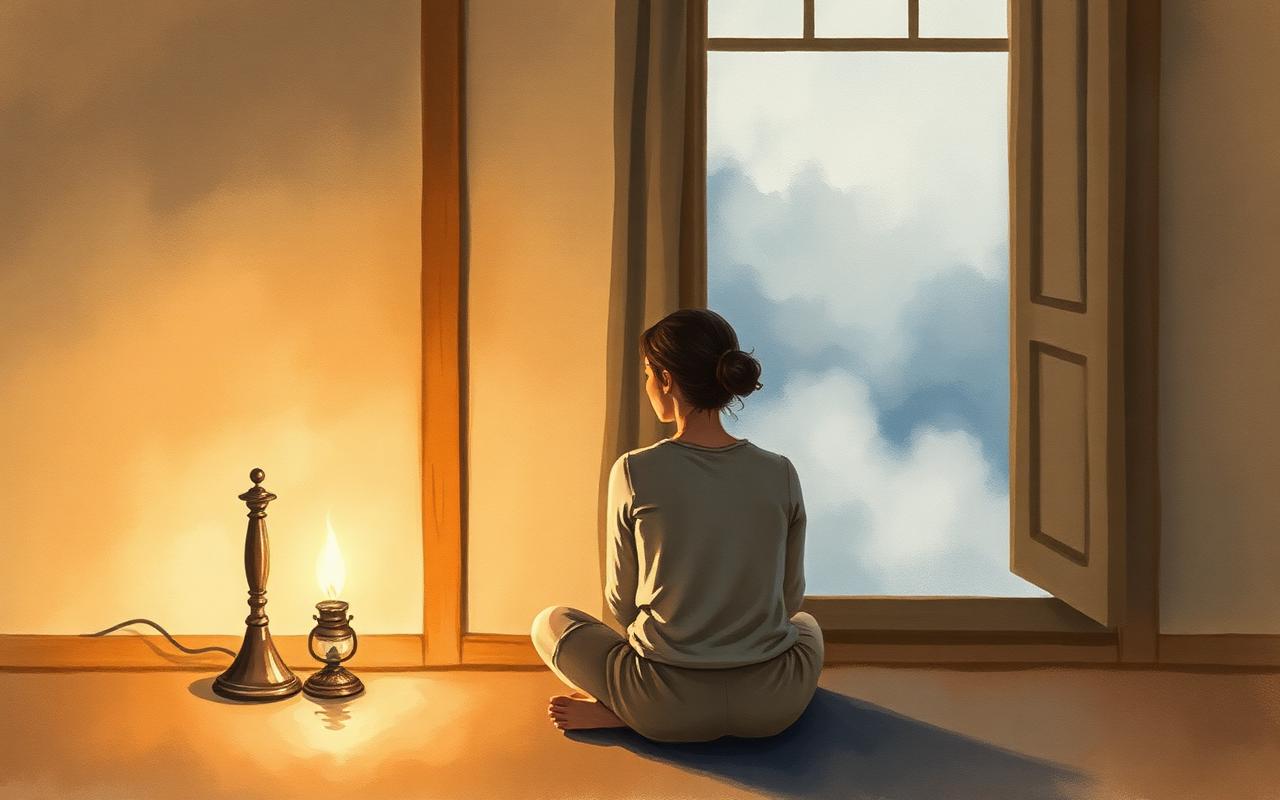
A person seated cross-legged at dawn beside a softly glowing oil lamp.
Early morning, beside a small lamp.

The Yoga Sutras describe the mind in terms not so different from those a computer engineer might use. The impressions we absorb through our senses — the vrittis — settle in the mind the way small viruses settle in software. Left alone, they begin to disturb the system. We call the result anxiety.

The mantra as a clearing program

Mantra meditation, in this image, is the cleanup. The holy name, repeated patiently, does not so much wrestle the mind into stillness as gently sweep its accumulated noise. What remains is the calmer field that was always underneath.

"We are not upset about what happens to us; rather, we are upset about what we think is happening to us."

Epictetus

Studies suggest that nearly half of adults in the West live with high levels of stress, much of it tied to work and money — and stress, untreated, gradually unravels both health and the simple ability to enjoy a day. Mantra meditation will not change the conditions of one's life overnight. But it will, slowly, change the room from which those conditions are met. That is its first quiet gift.

Adapted from a reflection by Vaisesika Dasa.

Permalink

Vaisesika Dasa

Vaisesika Dasa·March 18, 2026

A small sparrow flying out of an open kitchen window into golden afternoon light.
Afternoon light through a kitchen window.

One afternoon, while working in the back garden, I noticed a small wild bird had flown in through an open door and become trapped inside the house. Birds do not belong indoors, and I went in straightaway to set it free.

Whatever room I entered, I opened the windows wide. But each window made its small rattling sound, and the bird, terrified by it, fled into the next room ahead of me. I followed gently, speaking softly, closing doors behind me — and still, in its eyes, I was a giant whose only intention was harm.

Eventually, finding a single open window, the bird escaped. Just before it disappeared, it gave me one last frightened look, as if to say: I survived your cruelty.

An unfamiliar mirror

Sitting at the kitchen table afterward, the obvious comparison arrived. I am the bird. Some larger, gentler intelligence is constantly trying to help me toward the open window — and I, in my smaller view, mostly read its arrangements as misfortune, as injustice, as proof that the world is against me.

The Srimad-Bhagavatam suggests that this misreading is itself the trouble. Whatever appears in our lives is, in some final sense, meant for our good — a kind of cosmic sensitivity training, fitted to us with care. To live as if this were true is not to deny pain. It is only to relax, a little, the long-held suspicion that life is an ambush — and to begin, slowly, to feel grateful even for the difficult hours.

Adapted from a reflection by Vaisesika Dasa.

Permalink

Vaisesika Dasa

Vaisesika Dasa·February 22, 2026

Greed has a very short vocabulary. Whatever you offer it, its single response is the same: more. It does not know how to say thank you, because it cannot afford to. Gratitude is its quieter opposite — a divine quality, the tradition says, marked by a readiness to notice what was given and to return some kindness in turn.

Two cupped hands holding marigold petals in soft light.
An offering of marigolds.

Bhakti as the practice of thanks

The whole of bhakti yoga can be read as a long, patient cultivation of this one quality. Each chant, each offering, each small attention given to the holy name, is a way of saying — this was given to me, and I am noticing.

"When human society is grateful to the Lord for all His gifts for the maintenance of the living entities, then there is certainly no scarcity or want in society. But when men are unaware of the intrinsic value of such gifts from the Lord, surely they are in want."

Srimad-Bhagavatam 3.5.49

Want, in this reading, is less a condition of the world than a condition of attention. The cure begins where attention turns. Om Tat Sat. Adapted from a reflection by Vaisesika Dasa.

Permalink

Vaisesika Dasa

Vaisesika Dasa·January 14, 2026

An old proverb has been quietly waiting for us all along: if you chase two rabbits, both will escape. The frustration in this is familiar. To succeed at almost anything, one has to set a single clear goal, and stay with it long enough for the goal to recognise its pursuer.

A single narrow path winding through a quiet meadow at dusk.
A single path, at dusk.

In the Bhagavad-gita, Krishna says something almost identical, in the older register of the spiritual life:

"Those who are on this path are resolute in purpose, and their aim is one. O beloved child of the Kurus, the intelligence of those who are irresolute is many-branched."

Bhagavad-gita 2.41

One aim, gently held

Bhakti yogis, knowing Krishna to be the source of everything that pulls at our attention, settle on a single aim — to think of him, and to act in his service. Held this way, the mind is not so much narrowed as gathered. It begins, finally, to do its one good thing.

Adapted from a reflection by Vaisesika Dasa.

Permalink

Vaisesika Dasa

Vaisesika Dasa·December 15, 2025

Once, my wife and I stayed at a friend's apartment, where every closet was full of clothes still wearing their price tags, and the spare room held boxes of shoes that had never touched the street. She was, gently, in pursuit of a perfect outfit — convinced that if she could only assemble it, the right kind of joy would arrive on its own.

Two hands offering a steaming bowl of food across a wooden table by candlelight.
An ordinary table, an ordinary bowl, an ordinary hour.

I forgot all about her until, years later, I went into a shop for one pair of walking shoes. The salesperson appeared with two boxes and asked, almost casually, yellow or blue? Within a single second I had said yellow, then blue, then yellow again. On the way home I was still rehearsing the choice. I should have taken the blue.

Looking outside for what is inside

Spiritual beings, dressed for the moment in material bodies, struggle with material choices for as long as we mistake the costume for the wearer. Krishna says it as plainly as possible: the soul puts on new garments, giving up old ones, the way a person puts on new clothes. The shoes in my friend's apartment, and the small panic in mine, are, in that sense, the same kind of search.

The simple secret

Dale Carnegie, writing in another tradition entirely, arrives at the same conclusion as the bhakti texts. The fastest way out of one's own anxiety, he says, is to think of doing something good for someone else. The moment that thought is taken seriously, the small loop of self begins to loosen.

Once, as a young monk, I arrived at the lunch hall unusually hungry, only to find that the monk on serving duty had not appeared. I knew it was my turn to step in. I also knew I had wanted very much to sit down. Remembering my teacher's line — selfless service satisfies the soul's hunger — I picked up the ladle and began to serve. The longer I served, the less hungry I became, and the more clearly the room itself seemed to settle.

This is what bhakti yoga calls, in its older language, the yoga of love and gratitude. Practiced gently and often, it widens. Adapted from a reflection by Vaisesika Dasa.

Permalink