Fan The Spark

Category

Bhakti Notes

A small gathering of essays under bhakti notes.

Vaisesika Dasa

Vaisesika Dasa·May 10, 2026

We humans have very short lives. Measured by geological time, our lifespans are not even a nanosecond. Nonetheless, the bhakti scriptures say that this brief period is enough for anyone to attain spiritual perfection. What is more, they reprove as irresponsible and miserly those who do not utilize their lives to attain such perfection. Having so much at stake with so little time may seem daunting.

A drop of dew on a tulasi leaf, lit from behind by morning light.
Dawn on a tulasi leaf — a single instant, fully inhabited.

To inspire us, Sukadeva Goswami tells us in Srimad-Bhagavatam the story of Maharaja Khatvanga, who perfected his life within an instant. Srila Prabhupada summarizes Khatvanga's achievement plainly:

"King Khatvanga went to assist the demigods, and he was rewarded. When asked what he wanted, he replied, 'I want to know how long I shall live.' 'Not very long,' they said. 'A second.' He at once transferred his thoughts to Krishna and surrendered."

Srila Prabhupada, Back to Godhead Magazine #45

Not a license to wait

Maharaja Khatvanga's story is not meant to encourage procrastination. I can almost hear the convenient misreading: oh, this means I can do as I wish throughout my life and at the last moment remember Krishna. But Krishna and the great teachers of bhakti never encourage us to delay our spiritual practices in this way.

On the contrary, Sri Sukadeva tells us this story so that we may make each moment of our lives a Khatvanga moment. Though our lives are fleeting, they are made up of a series of moments — any one of which we may use to attain the supreme perfection of life by taking shelter of Krishna.

What seriousness actually does

Srila Prabhupada confirms this idea with a sentence worth keeping near the door of one's attention:

"Devotional service is not a material process — it is spiritual. It involves no impediments of material conditioning. It develops in proportion to one's seriousness; we can attain the whole thing in one second. If we sincerely take Krishna consciousness, we have it."

Srila Prabhupada (ibid.)

The instruction is exact and merciful at once. The door is always open. The hour need not be long. What is asked of us is only the willingness, this moment, to step quietly through it.
Permalink

Vaisesika Dasa

Vaisesika Dasa·April 22, 2026

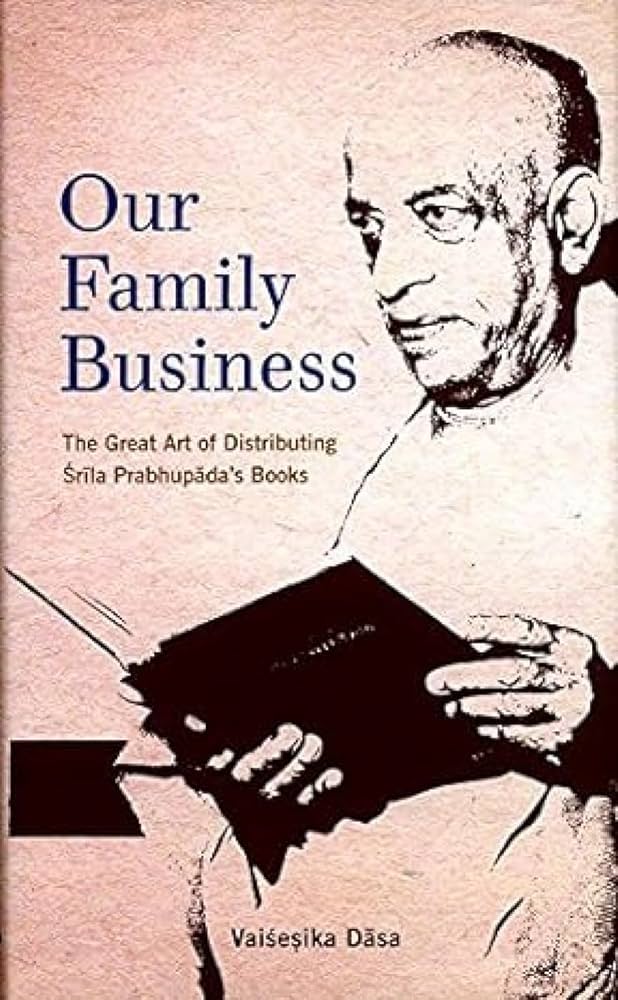
A painted book cover of a family at a hearth, navy and gold.
Our Family Business — a reading companion.

Every family is in some kind of business together. The visible part may be a shop, a profession, a farm, or simply the daily running of a household. But underneath that, every family is also producing something less visible — a culture, a memory, a set of values that the children will carry, half-consciously, into the rest of their lives.

Our Family Business is a small book about taking that second, hidden enterprise seriously. It proposes that the central work of a devotional household is not to add bhakti as one more activity on a busy calendar, but to reorganize the household's quiet inner economy around it — what we read aloud, what we eat, how we begin and end the day, what we celebrate, what we forgive.

What the book is really about

It is a manual, in the gentlest sense of the word. It walks through the small, repeatable practices that turn a home into a place of refuge: cooking and offering food with care, gathering for a few minutes of chanting, reading a verse together, keeping the festivals, welcoming guests as if they were sent. None of these are dramatic. All of them, kept up over years, change a family.

A reading companion, not a summary

These notes are not a substitute for the book itself. Think of them as a slow walk around the building before going inside. If something here moves you, the book is where the actual rooms are — with their furniture, their windows, their light.

Adapted from Our Family Business by Vaisesika Dasa.

Permalink

Vaisesika Dasa

Vaisesika Dasa·March 18, 2026

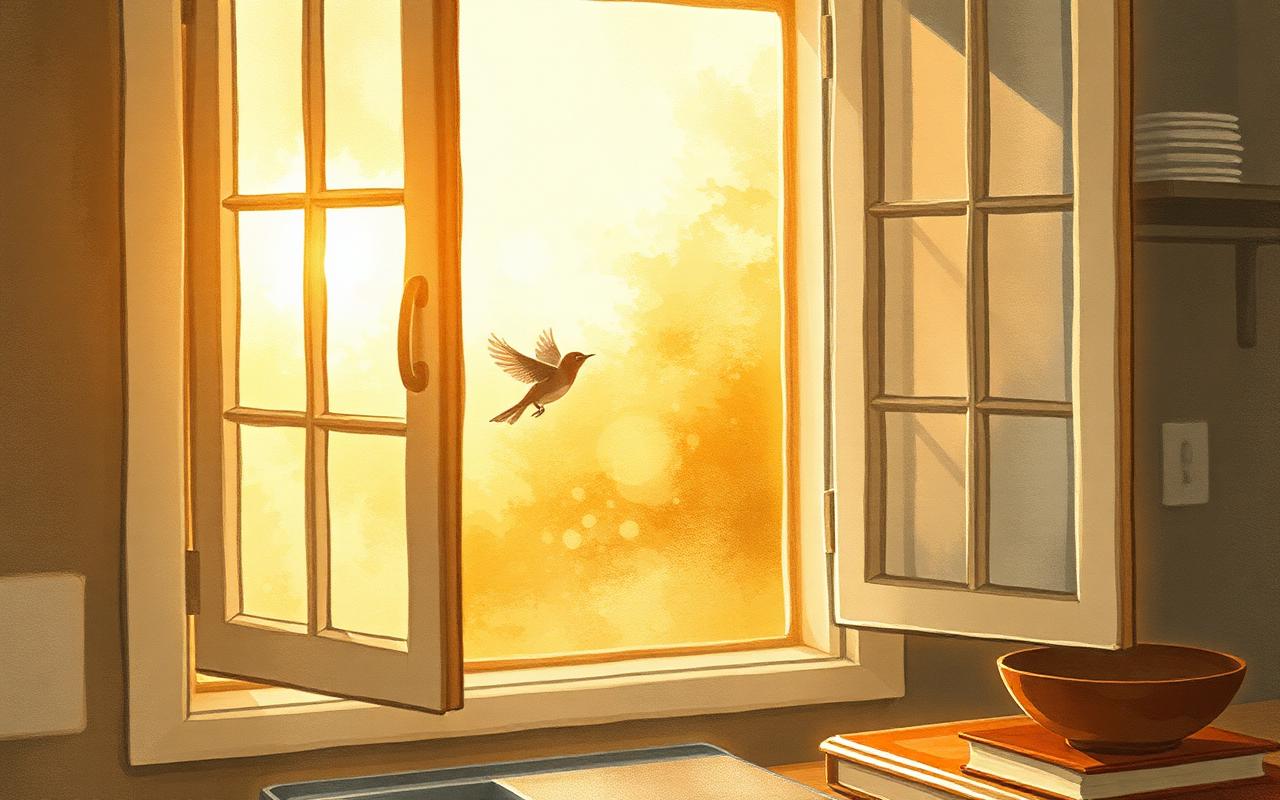
A small sparrow flying out of an open kitchen window into golden afternoon light.
Afternoon light through a kitchen window.

One afternoon, while working in the back garden, I noticed a small wild bird had flown in through an open door and become trapped inside the house. Birds do not belong indoors, and I went in straightaway to set it free.

Whatever room I entered, I opened the windows wide. But each window made its small rattling sound, and the bird, terrified by it, fled into the next room ahead of me. I followed gently, speaking softly, closing doors behind me — and still, in its eyes, I was a giant whose only intention was harm.

Eventually, finding a single open window, the bird escaped. Just before it disappeared, it gave me one last frightened look, as if to say: I survived your cruelty.

An unfamiliar mirror

Sitting at the kitchen table afterward, the obvious comparison arrived. I am the bird. Some larger, gentler intelligence is constantly trying to help me toward the open window — and I, in my smaller view, mostly read its arrangements as misfortune, as injustice, as proof that the world is against me.

The Srimad-Bhagavatam suggests that this misreading is itself the trouble. Whatever appears in our lives is, in some final sense, meant for our good — a kind of cosmic sensitivity training, fitted to us with care. To live as if this were true is not to deny pain. It is only to relax, a little, the long-held suspicion that life is an ambush — and to begin, slowly, to feel grateful even for the difficult hours.

Adapted from a reflection by Vaisesika Dasa.

Permalink

Vaisesika Dasa

Vaisesika Dasa·March 4, 2026

All our food, in the end, is sunlight that has been gathered up by the green leaves of plants and rearranged into something a body can take in. If the system had been built only for survival, one fruit and one vegetable would have been enough.

A still life of avocados, figs, kale and pomegranates in soft sunlight.
Avocados, figs, kale, pomegranates — sunlight in many costumes.

Instead, the world hands us thousands. Avocados, figs, mangoes, kale, peas, pomegranates, the whole long catalogue — each with its own taste, its own colour, its own season. None of this was strictly necessary. It was given, it seems, simply as a kindness.

To notice this, even briefly, is itself a small spiritual act. Gratitude, the bhakti tradition suggests, begins right here, at the table, with whatever is in the bowl in front of us.

Om Tat Sat. Adapted from a reflection by Vaisesika Dasa.

Permalink

Vaisesika Dasa

Vaisesika Dasa·February 10, 2026

The Oxford English Dictionary keeps a quiet record of how the word holy began. It is a near-cousin of whole — as in intact, undivided — and of healthy, and of an older English word, hale, meaning strong. (We still hear it in hale and hearty.) Holiday, then, is simply a compound: holy + day.

An old wooden door slightly ajar, warm light spilling onto stone steps.
An old door, slightly open.

Originally, a holy day was a day set aside — a festival, a vow, a deliberate stepping out of the usual current. In time, especially in the West, the word loosened into something more like a vacation: chiefly, a day off. Even the religious holidays now often retain only a thin shadow of their first intent.

A whole life

The bhakti tradition would say that holiness is less a calendar event than a quality of attention. To chant the holy names, to hear from Srimad-Bhagavatam, to give some small fruit of one's day toward something larger than oneself — this, in the old sense of the word, is a kind of being whole. Healthy, hale, satisfied, holy. The same single root.

Adapted from a reflection by Vaisesika Dasa.

Permalink

Vaisesika Dasa

Vaisesika Dasa·January 28, 2026

Some months ago, during a serious drought, I adjusted the small automatic watering system in our backyard, lowering the volume and the frequency. Within two and a half months the garden had quietly given up — leaves dry, growth stalled, the figs paused mid-effort.

A small lush garden after rain, water droplets on green leaves and ripening fruit.
A garden, two weeks after the small adjustment.

Two weeks ago I increased the daily water by five percent. Just five. The garden has begun to perk up: green tips returning, the figs filling out again, even a rose or two emerging from the brown.

The arithmetic of practice

It is hard not to see in this a small parable for spiritual life. A five-percent increase in one's daily bhakti practice — a slightly longer round of chanting, one more chapter heard, a few more minutes given to service — is often enough to revive a wilting taste for it. The change need not be dramatic to be real.

The bhakti scriptures advise us, accordingly, to keep a careful eye on our daily intake of devotional water. Not because the soul is fragile, but because attention is. Adapted from a reflection by Vaisesika Dasa.

Permalink

Vaisesika Dasa

Vaisesika Dasa·December 1, 2025

What is Krishna consciousness?

Krishna is one of the names of God in the Vedic tradition, indicating supreme beauty and an all-attractive nature. Krishna consciousness is, in plain terms, the soul's natural state — quietly absorbed in loving service to that all-attractive source. It is not something added to us from outside; it is what we have always been, momentarily forgotten under the conditions of material life. As one moves a little away from the loud demands of the senses, this older state begins to recover itself, and a more stable kind of happiness becomes possible.

An open antique book on a wooden table, golden morning light over its pages, a small brass bell beside it.
An open book, early in the morning.

Where does this tradition come from?

Its roots are in the Vedas, among the oldest scriptures of the world. In its present-day form, the path of devotional chanting was given a particular shape by Sri Caitanya Mahaprabhu in Bengal, India, about five hundred years ago. In 1965, A. C. Bhaktivedanta Swami Prabhupada brought the same teaching to the West, and the international community of practice that grew up around him has temples and farms today on every continent.

What are the Vedas?

The Vedas are an extensive body of Sanskrit literature concerning, broadly, the nature of the self, the world, and the divine. They include the four original Vedas, the Upanishads, the great epics like the Mahabharata (which contains the Bhagavad-gita), and the Puranas, of which the Srimad-Bhagavatam is, for bhakti practitioners, the most beloved.

What does a daily practice actually look like?

At its simplest: chanting the Hare Krishna mantra (often on beads), reading a little from the Bhagavad-gita or Srimad-Bhagavatam, eating food that has been offered with care, and giving some small portion of one's day to the welfare of others. The path is not asking for heroic gestures. It is asking for a little, daily, kept up gently over time.

Adapted from a reference page by Vaisesika Dasa and the FanTheSpark team.

Permalink