While visiting Southern California last weekend we passed by an organic produce store named, Fresh and Easy.
I thought that moniker to be a good description of the process of bhakti yoga, which is also fresh and easy.
"What experienced listener, O brahmana, could ever grow satiated while listening to the pious, charming and ever-fresh topics of Lord Krishna, which cleanse away the world's contamination?"
— Srimad-Bhagavatam 10.52.20
"For one who always remembers Me without deviation, I am easy to obtain, O son of Prtha, because of his constant engagement in devotional service."
While transiting the Bangkok airport I saw an advertisement in front of a sporting good store featuring the following quote from famous Argentine footballer, Leo Messi: “I trained 17 years to be an overnight success.”
Messi's slogan reminded me about the importance of being patient in one's practice of devotional service. The process of bhakti is so powerful that a steady effort over time will bring unimaginable rewards.
Practicing patience means that one may have to tolerate even one's own shortcomings, going on with the process with confidence that Krishna is so powerful that he can and will elevate even the slowest or most unqualified practitioners.
"One should not be discouraged in the discharge of devotional service. Failures may not be detrimental; they may be the pillars of success. One must have good faith in the regulative principles followed by the self-realized souls, and one should not be doubtful about the ultimate result of such devotional service . . . We should not consider going back to Godhead a plaything. We must take it seriously, as enjoined in the scriptures. For a strict follower, the result is sure and certain, and when the time is right the result will come of its own force."
— Srila Prabhupada — Light of the Bhagavata, Verse 43
Voltaire wrote: “Appreciation is a wonderful thing: It makes what is excellent in others belong to us as well.”
And in her prayer about the power of bhakti, Queen Kunti uses the word, ”grnanti” (“appreciating”) to say that those who appreciate other’s devotional service are themselves performing high grade devotional service, just by deeply appreciating how others are doing their service. Queen Kunti says, these “appreciators” will come to see the Lord directly.
As we become purified, our ability to appreciate Krsna and His devotees increases more and more.
Really, the soul is naturally and eternally an appreciator. The Vedas say: eko bahu-syam: “The one Lord has become many.” Why? Vedanta Sutra answers: Anandamayo bhyasat, “For enjoyment.” In other words, the soul, Krsna’s part and parcel, exists for Krsna’s pleasure and has the eternal privilege of appreciating Krsna, Krsna’s devotees, and the process of devotional service.
Krsna is an ocean of attractiveness, but what makes His attractiveness forever increase is the dynamic relationship between Him and His devotees. “A pure devotee does not want anything from Krsna; he simply wants to serve Him. And Krsna also looks for the opportunity to serve His devotee. Krsna is always as anxious to please His devotee as the devotee is to please Him . . . This is spiritual competition.” SSR 8
Seeing Radharani (Krsna’s supreme appreciator) Krsna thinks: “There is constant competition between My sweetness and the mirror of Radha’s love. They both go on increasing, but neither knows defeat.” (Cc Adi 4.142) “Whatever pleasure I get from tasting My love for Srimati Radharani, She tastes ten million times more than Me by Her love.” (Cc Adi 4.126)
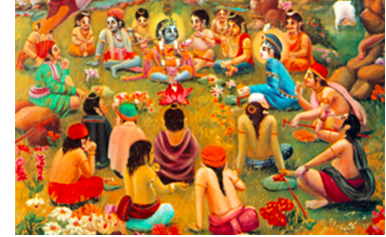
Appreciation for Krsna moves the devotee to smile, to dance and to serve. In his Samhita, Brahma describes how in Goloka, “every word is a song, every gait is a dance.” There the residents move out of a joy driven by their overflowing appreciation for Krsna, Krsna’s devotees and devotional service.
To this end, one evening during our hari nama sankirtana performance in Palo Alto, CA, I watched as an elderly women smiled broadly upon beholding our devotees chanting blissfully on the sidewalk. Soon the force of her appreciation moved her to clap her hands to the beat of the kirtana; soon after that she swayed with obvious happiness, waving her hands in the air.
People spend their whole lives looking for things and people to appreciate. They flock to natural scenes like the Grand Canyon, eulogize talented or famous singers, writers and athletes, and gaze at beauty in all its forms . . .
Bhakti yoga is the simple act of connecting all such appreciations to Krsna and His devotees. Watering these seeds of appreciation brings forth the beautiful creeper of prema, pure love for the Supreme Person, the only true satisfaction of the soul.
Humbly in service and with deep appreciation of your association,
Recently, my computer picked up a virus. The same message kept popping up on my screen and no matter how many times I deleted it, it came back. I was busy with a deadline and I couldn't afford to lose time. So I called an expert who told me how to run an anti-virus program. I did, and afterwards my computer system was clean and working well.
Yoga texts, like the Yoga Sutras, describe our minds and physical bodies the way computer engineers describe software and hardware. Just as viruses infect computer software, outside influences similarly affect our minds. These mind viruses are called vrittis, or impressions that we take in through our senses from the world around us.
A calm mind: the goal of mantra meditation.
And a disturbed mind brings us anxiety. Practicing mantra meditation is just like running an antivirus program that clears the mind. And when the mind is clear and calm one feels inner peace. The Yoga Sutras, the original guidebook to meditation, says that we are spiritual beings, or pure consciousness, but we now live within bodies made of gross and subtle matter.
They explain how our minds are affected by what we expose ourselves to and that because of this how we assume varying degrees of focus: wondering, confused, distracted. Those who identify themselves with their minds, feel themselves to be going through these changes themselves, the way a person identifying with a movie goes through emotional changes according to what he or she sees on the screen.
"We are not upset about what happens to us; rather, we are upset about what we think is happening to us."
— Epictetus
Stress has become one of our modern societies' biggest problems. A recent study from the American Psychological Association found that nearly half of American adults experience high levels of stress especially over work and money. It not only causes numerous diseases like hypertension, depression, and obesity, but also takes away from our natural tendency and ability to appreciate life.
Without peace of mind we cannot find happiness, no matter where we live or what things we have. Those who practice mantra meditation can bring their minds to elevated states that the Yoga Sutras call concentrated and restrained. When our minds become calm, we see for ourselves that we have a life beyond both our minds and physical bodies.
Anyone can calm the turbulent mind by mantra meditation to become aware of his or her inner spiritual identity and feel satisfaction. Such inner satisfaction is the first symptom of self-realization.
Any thought of achieving comfort in this material world is Maya. In Srila Bhaktivinoda's song Jiv Jago, Lord Caitanya asks, 'How long will you sleep in the lap of the witch called Maya?'
Bhagavad-gita is our wake up call. But we must be ready to hear it.
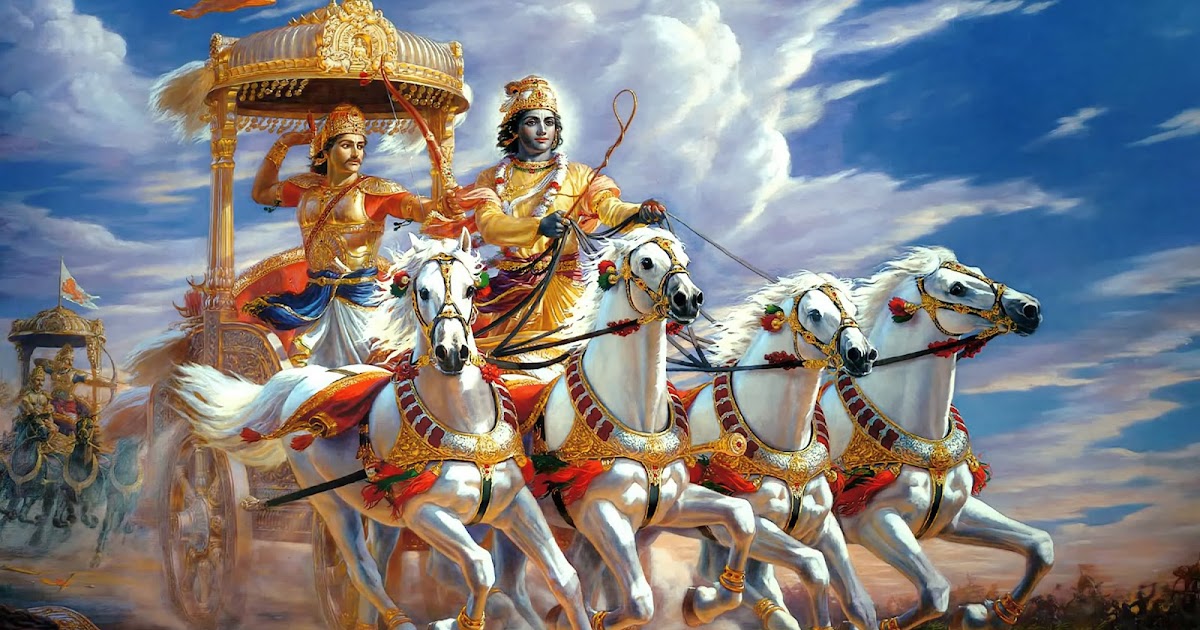
Only after Arjuna had plummeted into a pit of despair was he ready to hear Krsna speak His divine instructions. Despair derives from Latin, desperare, de — 'down from' + sperare 'to hope'. In other words, Arjuna had lost hope in his own abilities to find a solution to his problems. His optimism ran dry; and with no apparent solution to his grave dilemma, tears came to his eyes and he dropped his mighty bow, Gandiva.
Actually, everyone in the material world is in such a precarious and hopeless situation.
However, in Maya's warm embrace, I think that I am Okay. But I am not. The forceful wheel of time will soon loosen my grip on all that I now possess. My cherished hopes for comfort, permanency and happiness in the material world will slip away.
In his introduction to Bhagavad-gita As It Is, Srila Prabhupada writes:
"Actually we are all swallowed by the tigress of nescience, but the Lord is very merciful upon living entities, especially human beings. To this end He spoke the Bhagavad-gita, making His friend Arjuna His student."
— Bhagavad-gita Introduction, p. 6
Krishna becomes Arjuna's charioteer — and ours, when we are ready to hear.
Before hearing Bhagavad-gita we will benefit greatly by remembering how we too are swallowed by the tigress of nescience. Like Arjuna, are we also not helpless and lost without hearing and surrendering to Krsna's sweet words?
As Arjuna set aside his bow and arrows, let us set aside any sense of confidence in our own abilities, so that we may hear Krsna's words with full heart and attention.
This kind of submissive hearing is the primary requirement for advancement in spiritual life. The devotee who hears Krsna's words with a submissive heart immediately feels ingress of causeless knowledge and detachment.
Near the end of Bhagavad-gita Krsna tells Arjuna:
"In all activities just depend upon Me and work always under My protection. In such devotional service, be fully conscious of Me."
— Bhagavad-gita 18.57
Krsna is attentively watching us at every second and is ready to guide and shelter us.
Therefore, today, and every day, may we recite the divine slokas in Bhagavad-gita not by rote. Rather, with the urgency of a man or woman trapped in a burning house, let us sing them aloud, calling for Krsna's protection.
Hare Krishna! With gratitude and affection, Vaisesika Dasa
There are questions that are useful for an afternoon, and there are questions that are useful for a life. The Four Questions belongs to the second kind. It returns, patiently, to a small set of inquiries that the Vedic tradition has handed down for centuries — questions about who I am, where I came from, what I am supposed to be doing here, and where I am going next.
The book's wager is simple: most of our suffering is downstream of never having actually sat with these questions. We answer them implicitly, by the way we spend our days, but we rarely answer them on purpose. When we finally do, the answers begin to gently rearrange the furniture of the mind.
Why four, and why these four
These are not riddles. They are diagnostic. Each one shines a light on a layer of identity that is easy to forget — the body, the mind, the soul, and the relationship between the soul and its source. Together they form a small examination that any thoughtful person can carry around in a pocket, returning to whenever life feels noisier than it should.
How to use this companion
These notes are an invitation, not a summary. The book itself is unhurried and conversational; it deserves to be read slowly, perhaps a chapter at a time, with a notebook nearby. If anything here makes you curious, follow the link to the book and let it do the deeper work.
Adapted from The Four Questions, with gratitude to its authors.
Every family is in some kind of business together. The visible part may be a shop, a profession, a farm, or simply the daily running of a household. But underneath that, every family is also producing something less visible — a culture, a memory, a set of values that the children will carry, half-consciously, into the rest of their lives.
Our Family Business is a small book about taking that second, hidden enterprise seriously. It proposes that the central work of a devotional household is not to add bhakti as one more activity on a busy calendar, but to reorganize the household's quiet inner economy around it — what we read aloud, what we eat, how we begin and end the day, what we celebrate, what we forgive.
What the book is really about
It is a manual, in the gentlest sense of the word. It walks through the small, repeatable practices that turn a home into a place of refuge: cooking and offering food with care, gathering for a few minutes of chanting, reading a verse together, keeping the festivals, welcoming guests as if they were sent. None of these are dramatic. All of them, kept up over years, change a family.
A reading companion, not a summary
These notes are not a substitute for the book itself. Think of them as a slow walk around the building before going inside. If something here moves you, the book is where the actual rooms are — with their furniture, their windows, their light.
Adapted from Our Family Business by Vaisesika Dasa.
Krishna is one of the names of God in the Vedic tradition, indicating supreme beauty and an all-attractive nature. Krishna consciousness is, in plain terms, the soul's natural state — quietly absorbed in loving service to that all-attractive source. It is not something added to us from outside; it is what we have always been, momentarily forgotten under the conditions of material life. As one moves a little away from the loud demands of the senses, this older state begins to recover itself, and a more stable kind of happiness becomes possible.
Where does this tradition come from?
Its roots are in the Vedas, among the oldest scriptures of the world. In its present-day form, the path of devotional chanting was given a particular shape by Sri Caitanya Mahaprabhu in Bengal, India, about five hundred years ago. In 1965, A. C. Bhaktivedanta Swami Prabhupada brought the same teaching to the West, and the international community of practice that grew up around him has temples and farms today on every continent.
What are the Vedas?
The Vedas are an extensive body of Sanskrit literature concerning, broadly, the nature of the self, the world, and the divine. They include the four original Vedas, the Upanishads, the great epics like the Mahabharata (which contains the Bhagavad-gita), and the Puranas, of which the Srimad-Bhagavatam is, for bhakti practitioners, the most beloved.
What does a daily practice actually look like?
At its simplest: chanting the Hare Krishna mantra (often on beads), reading a little from the Bhagavad-gita or Srimad-Bhagavatam, eating food that has been offered with care, and giving some small portion of one's day to the welfare of others. The path is not asking for heroic gestures. It is asking for a little, daily, kept up gently over time.
Adapted from a reference page by Vaisesika Dasa and the FanTheSpark team.
Once, my wife and I stayed at a friend's apartment, where every closet was full of clothes still wearing their price tags, and the spare room held boxes of shoes that had never touched the street. She was, gently, in pursuit of a perfect outfit — convinced that if she could only assemble it, the right kind of joy would arrive on its own.
I forgot all about her until, years later, I went into a shop for one pair of walking shoes. The salesperson appeared with two boxes and asked, almost casually, yellow or blue? Within a single second I had said yellow, then blue, then yellow again. On the way home I was still rehearsing the choice. I should have taken the blue.
Looking outside for what is inside
Spiritual beings, dressed for the moment in material bodies, struggle with material choices for as long as we mistake the costume for the wearer. Krishna says it as plainly as possible: the soul puts on new garments, giving up old ones, the way a person puts on new clothes. The shoes in my friend's apartment, and the small panic in mine, are, in that sense, the same kind of search.
The simple secret
Dale Carnegie, writing in another tradition entirely, arrives at the same conclusion as the bhakti texts. The fastest way out of one's own anxiety, he says, is to think of doing something good for someone else. The moment that thought is taken seriously, the small loop of self begins to loosen.
Once, as a young monk, I arrived at the lunch hall unusually hungry, only to find that the monk on serving duty had not appeared. I knew it was my turn to step in. I also knew I had wanted very much to sit down. Remembering my teacher's line — selfless service satisfies the soul's hunger — I picked up the ladle and began to serve. The longer I served, the less hungry I became, and the more clearly the room itself seemed to settle.
This is what bhakti yoga calls, in its older language, the yoga of love and gratitude. Practiced gently and often, it widens. Adapted from a reflection by Vaisesika Dasa.
The verb prepare means simply: to make something ready for use, or for consideration. It sounds modest. And yet the people who think most carefully about a life keep returning to it.
"Opportunity is a haughty goddess who wastes no time with those who are unprepared."
"All things are ready, if our mind be so."
Across centuries and very different vocabularies, the same small claim recurs: our destiny — in this life, and beyond it — is largely shaped by how we prepare for it now.
Or, said more simply
Our preparation leads us to our destination.
The bhakti teachers extend the sentence one step further. This short life, they say, is itself a kind of preparation room. Srila Prabhupada writes plainly: by our activities here we either rise or sink, and what we make ready in this body is what we will be carried into in the next. The current hour, in this view, is not background. It is the work.
An old proverb has been quietly waiting for us all along: if you chase two rabbits, both will escape. The frustration in this is familiar. To succeed at almost anything, one has to set a single clear goal, and stay with it long enough for the goal to recognise its pursuer.
In the Bhagavad-gita, Krishna says something almost identical, in the older register of the spiritual life:
"Those who are on this path are resolute in purpose, and their aim is one. O beloved child of the Kurus, the intelligence of those who are irresolute is many-branched."
One aim, gently held
Bhakti yogis, knowing Krishna to be the source of everything that pulls at our attention, settle on a single aim — to think of him, and to act in his service. Held this way, the mind is not so much narrowed as gathered. It begins, finally, to do its one good thing.
Some months ago, during a serious drought, I adjusted the small automatic watering system in our backyard, lowering the volume and the frequency. Within two and a half months the garden had quietly given up — leaves dry, growth stalled, the figs paused mid-effort.
Two weeks ago I increased the daily water by five percent. Just five. The garden has begun to perk up: green tips returning, the figs filling out again, even a rose or two emerging from the brown.
The arithmetic of practice
It is hard not to see in this a small parable for spiritual life. A five-percent increase in one's daily bhakti practice — a slightly longer round of chanting, one more chapter heard, a few more minutes given to service — is often enough to revive a wilting taste for it. The change need not be dramatic to be real.
The bhakti scriptures advise us, accordingly, to keep a careful eye on our daily intake of devotional water. Not because the soul is fragile, but because attention is. Adapted from a reflection by Vaisesika Dasa.
The Oxford English Dictionary keeps a quiet record of how the word holy began. It is a near-cousin of whole — as in intact, undivided — and of healthy, and of an older English word, hale, meaning strong. (We still hear it in hale and hearty.) Holiday, then, is simply a compound: holy + day.
Originally, a holy day was a day set aside — a festival, a vow, a deliberate stepping out of the usual current. In time, especially in the West, the word loosened into something more like a vacation: chiefly, a day off. Even the religious holidays now often retain only a thin shadow of their first intent.
A whole life
The bhakti tradition would say that holiness is less a calendar event than a quality of attention. To chant the holy names, to hear from Srimad-Bhagavatam, to give some small fruit of one's day toward something larger than oneself — this, in the old sense of the word, is a kind of being whole. Healthy, hale, satisfied, holy. The same single root.
Greed has a very short vocabulary. Whatever you offer it, its single response is the same: more. It does not know how to say thank you, because it cannot afford to. Gratitude is its quieter opposite — a divine quality, the tradition says, marked by a readiness to notice what was given and to return some kindness in turn.
Bhakti as the practice of thanks
The whole of bhakti yoga can be read as a long, patient cultivation of this one quality. Each chant, each offering, each small attention given to the holy name, is a way of saying — this was given to me, and I am noticing.
"When human society is grateful to the Lord for all His gifts for the maintenance of the living entities, then there is certainly no scarcity or want in society. But when men are unaware of the intrinsic value of such gifts from the Lord, surely they are in want."
Want, in this reading, is less a condition of the world than a condition of attention. The cure begins where attention turns. Om Tat Sat. Adapted from a reflection by Vaisesika Dasa.
All our food, in the end, is sunlight that has been gathered up by the green leaves of plants and rearranged into something a body can take in. If the system had been built only for survival, one fruit and one vegetable would have been enough.
Instead, the world hands us thousands. Avocados, figs, mangoes, kale, peas, pomegranates, the whole long catalogue — each with its own taste, its own colour, its own season. None of this was strictly necessary. It was given, it seems, simply as a kindness.
To notice this, even briefly, is itself a small spiritual act. Gratitude, the bhakti tradition suggests, begins right here, at the table, with whatever is in the bowl in front of us.
Om Tat Sat. Adapted from a reflection by Vaisesika Dasa.
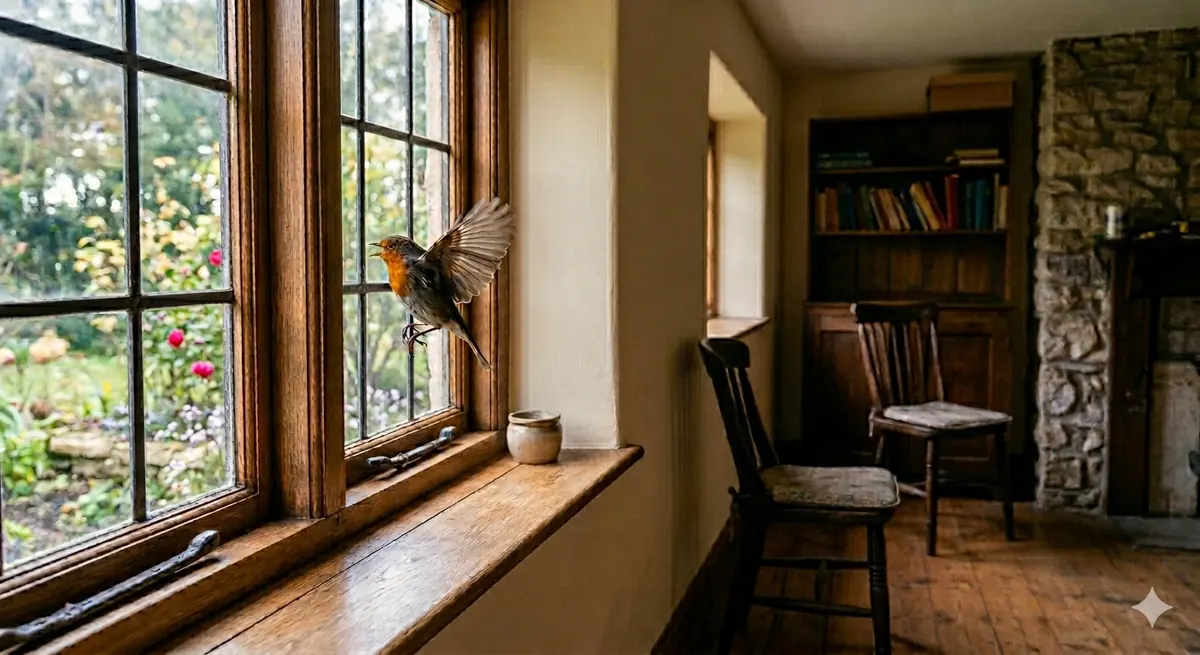
One afternoon, while working in the back garden, I noticed a small wild bird had flown in through an open door and become trapped inside the house. Birds do not belong indoors, and I went in straightaway to set it free.
Whatever room I entered, I opened the windows wide. But each window made its small rattling sound, and the bird, terrified by it, fled into the next room ahead of me. I followed gently, speaking softly, closing doors behind me — and still, in its eyes, I was a giant whose only intention was harm.
Eventually, finding a single open window, the bird escaped. Just before it disappeared, it gave me one last frightened look, as if to say: I survived your cruelty.
An unfamiliar mirror
Sitting at the kitchen table afterward, the obvious comparison arrived. I am the bird. Some larger, gentler intelligence is constantly trying to help me toward the open window — and I, in my smaller view, mostly read its arrangements as misfortune, as injustice, as proof that the world is against me.
The Srimad-Bhagavatam suggests that this misreading is itself the trouble. Whatever appears in our lives is, in some final sense, meant for our good — a kind of cosmic sensitivity training, fitted to us with care. To live as if this were true is not to deny pain. It is only to relax, a little, the long-held suspicion that life is an ambush — and to begin, slowly, to feel grateful even for the difficult hours.
Once, while working on a deadline, my computer caught a small persistent virus. The same alert kept reappearing, no matter how many times I dismissed it. Eventually a friend who knew the system walked me through running the right cleanup program, and the machine returned to itself.
The Yoga Sutras describe the mind in terms not so different from those a computer engineer might use. The impressions we absorb through our senses — the vrittis — settle in the mind the way small viruses settle in software. Left alone, they begin to disturb the system. We call the result anxiety.
The mantra as a clearing program
Mantra meditation, in this image, is the cleanup. The holy name, repeated patiently, does not so much wrestle the mind into stillness as gently sweep its accumulated noise. What remains is the calmer field that was always underneath.
"We are not upset about what happens to us; rather, we are upset about what we think is happening to us."
Studies suggest that nearly half of adults in the West live with high levels of stress, much of it tied to work and money — and stress, untreated, gradually unravels both health and the simple ability to enjoy a day. Mantra meditation will not change the conditions of one's life overnight. But it will, slowly, change the room from which those conditions are met. That is its first quiet gift.
You are an atma, a spiritual entity that has nothing at all to do with this material world. You cannot be killed, cut, burned, or drowned. You are eternal.
Feel better now?
Finer than intelligence
"Finer than intelligence is the soul, which is not matter like mind and intelligence but is spirit, or antimatter. The soul is hundreds of thousands of times finer and more powerful than intelligence."
We forget this most of the time, and the forgetting is itself a kind of weather we live inside. The reminder, when it arrives — in a verse, in a teacher's sentence, in the small clearing of an unhurried morning — does not add anything new. It only restores what was already, quietly, the case.
Bhakti yogis carefully control their senses and minds by engaging them in service to Krishna and Krishna's devotees. The control is not the white-knuckle restraint we tend to imagine when we hear the word discipline. It is, instead, the quieter and more lasting work of giving the senses something better to do.
"Thus practicing constant control of the body, mind and activities, the mystic transcendentalist, his mind regulated, attains to the kingdom of God by cessation of material existence."
Constant, not occasional
The Gita's word is constant. Not heroic, not occasional, not reserved for the dramatic morning. The senses are practiced the way a musician practices scales — daily, gently, without spectacle. The mind, after long enough, learns the new song.
And so the small interior weather of the practitioner begins to change. The room of the chest, once crowded, becomes a room one can return to. The senses, once scattered, begin to point in the same direction — toward the holy name, toward the service at hand, toward the next quiet hour.
There is no spectacle in this. There is only, slowly, a life that has become its own steady practice.
We humans have very short lives. Measured by geological time, our lifespans are not even a nanosecond. Nonetheless, the bhakti scriptures say that this brief period is enough for anyone to attain spiritual perfection. What is more, they reprove as irresponsible and miserly those who do not utilize their lives to attain such perfection. Having so much at stake with so little time may seem daunting.
To inspire us, Sukadeva Goswami tells us in Srimad-Bhagavatam the story of Maharaja Khatvanga, who perfected his life within an instant. Srila Prabhupada summarizes Khatvanga's achievement plainly:
"King Khatvanga went to assist the demigods, and he was rewarded. When asked what he wanted, he replied, 'I want to know how long I shall live.' 'Not very long,' they said. 'A second.' He at once transferred his thoughts to Krishna and surrendered."
Not a license to wait
Maharaja Khatvanga's story is not meant to encourage procrastination. I can almost hear the convenient misreading: oh, this means I can do as I wish throughout my life and at the last moment remember Krishna. But Krishna and the great teachers of bhakti never encourage us to delay our spiritual practices in this way.
On the contrary, Sri Sukadeva tells us this story so that we may make each moment of our lives a Khatvanga moment. Though our lives are fleeting, they are made up of a series of moments — any one of which we may use to attain the supreme perfection of life by taking shelter of Krishna.
What seriousness actually does
Srila Prabhupada confirms this idea with a sentence worth keeping near the door of one's attention:
"Devotional service is not a material process — it is spiritual. It involves no impediments of material conditioning. It develops in proportion to one's seriousness; we can attain the whole thing in one second. If we sincerely take Krishna consciousness, we have it."
The instruction is exact and merciful at once. The door is always open. The hour need not be long. What is asked of us is only the willingness, this moment, to step quietly through it.